
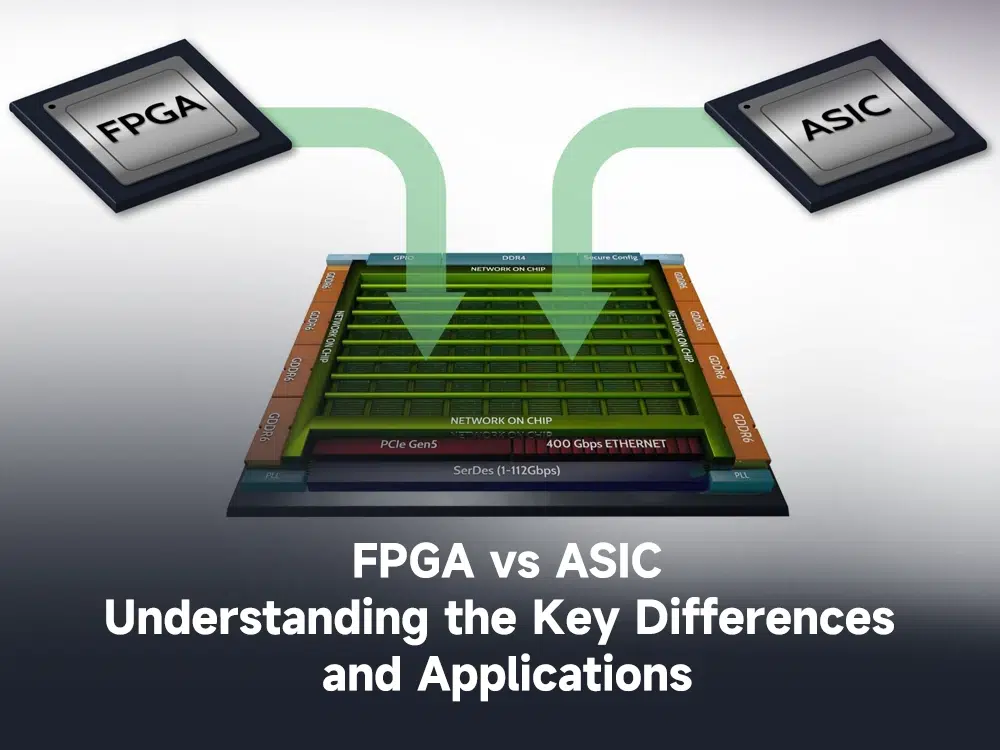
In the fast-evolving semiconductor industry, selecting the right hardware development approach is critical for the success of your electronic product. Whether you are building an AI accelerator, automotive chip, IoT device, consumer electronics product, or high-performance computing solution, the decision often comes down to FPGA vs ASIC.
Both FPGA (Field Programmable Gate Array) and ASIC (Application-Specific Integrated Circuit) play vital roles in VLSI chip design services, but each comes with unique advantages, limitations, costs, and development timelines.
In this blog, we will explore the differences between FPGA and ASIC design services, helping businesses determine the best choice for their project requirements.
What is FPGA in VLSI Design?
FPGA (Field Programmable Gate Array) is a programmable semiconductor device that can be configured after manufacturing. Unlike fixed chips, FPGAs offer flexibility, making them ideal for prototyping and applications requiring updates or modifications.
FPGA devices are commonly used in:
- Prototyping for ASIC development
- Telecommunications systems
- Automotive electronics
- Aerospace and defense systems
- AI and machine learning acceleration
- Embedded systems and IoT applications
Key Benefits of FPGA Design Services
1. Faster Development Time
FPGA development cycles are much shorter than ASICs because there is no need for chip fabrication.
2. Reprogrammability
One of the biggest advantages of FPGA is flexibility. Engineers can update the hardware configuration multiple times even after deployment.
3. Lower Initial Cost
FPGA development requires less upfront investment, making it suitable for startups and low-volume production.
4. Ideal for Prototyping
Many semiconductor companies use FPGA prototyping before committing to ASIC manufacturing.
Challenges of FPGA
- Higher per-unit cost in mass production
- Lower performance compared to ASIC
- Higher power consumption
- Limited optimization possibilities
What is ASIC in VLSI Design?
ASIC (Application-Specific Integrated Circuit) is a custom-designed chip built for a specific function or application. Unlike FPGA, ASIC hardware cannot be reprogrammed after fabrication.
ASIC chips are widely used in:
- Smartphones
- Automotive systems
- Data centers
- Medical devices
- Consumer electronics
- AI chips and processors
- Networking hardware
Key Benefits of ASIC Design Services
1. High Performance
ASIC chips are optimized for dedicated functions, delivering superior speed and performance.
2. Lower Power Consumption
Power efficiency is one of the biggest reasons companies prefer ASIC for production-level semiconductor devices.
3. Cost Efficient in High Volume
Although ASIC development has high upfront costs, per-unit manufacturing cost becomes much lower at scale.
4. Better Security
Since ASICs are custom-designed and fixed-function, they are generally more secure than programmable hardware.
Challenges of ASIC
- Higher NRE (Non-Recurring Engineering) cost
- Longer development cycle
- No post-production reprogramming
- Higher project risk if design errors occur
FPGA vs ASIC: Key Differences
| Feature | FPGA | ASIC |
| Flexibility | Highly Reprogrammable | Fixed Function |
| Development Cost | Lower | Higher |
| Production Cost | High per unit | Low at scale |
| Performance | Moderate | High |
| Power Consumption | Higher | Lower |
| Time to Market | Faster | Longer |
| Best For | Prototyping, low-volume products | Mass production |
When Should You Choose FPGA?
if You should choose FPGA design services :
- Your project requires rapid development
- You need frequent updates or modifications
- You are building a prototype before ASIC fabrication
- Production volume is low to medium
- Budget constraints are important
FPGA is an excellent choice for proof-of-concept semiconductor projects, especially in startups and R&D environments.
When Should You Choose ASIC?
You should choose ASIC design services if:
- Your product is moving toward mass production
- High performance is critical
- Low power consumption is essential
- Long-term manufacturing cost reduction matters
- Your design specifications are finalized
For enterprise-level semiconductor solutions, ASIC often provides the best long-term return on investment.
FPGA to ASIC Migration: The Smart Approach
Many semiconductor companies begin with FPGA prototyping and later migrate to ASIC chip design once the product matures.
This strategy helps businesses:
- Validate designs faster
- Reduce engineering risk
- Test real-world performance
- Save development costs initially
At VLSI Monks, our experts help clients with FPGA design, ASIC design, RTL design, physical design, verification services, and complete VLSI solutions to accelerate semiconductor innovation.
How to Choose the Right VLSI Service for Your Project?
Choosing between FPGA and ASIC depends on multiple factors:
1. Budget
If you have limited upfront investment, FPGA may be the better option.
2. Production Volume
High-volume products benefit more from ASIC manufacturing.
3. Performance Requirements
ASIC provides better speed, optimization, and efficiency.
4. Time to Market
FPGA enables faster deployment.
5. Future Modifications
If hardware updates are expected, FPGA offers flexibility.
Working with an experienced VLSI service provider ensures your semiconductor project gets the right architecture from day one.
Why Choose VLSI Monks for FPGA and ASIC Services?
At VLSI Monks, we specialize in end-to-end semiconductor solutions tailored to industry requirements.
✔ FPGA Design Services
✔ ASIC Design Services
✔ RTL Design & Verification
✔ Physical Design Services
✔ DFT (Design for Testability)
✔ Semiconductor Consulting
✔ End-to-End VLSI Engineering Support
Whether you’re a startup building a new semiconductor product or an enterprise optimizing chip performance, our experienced engineers help bring your vision to silicon.
Final Thoughts
The FPGA vs ASIC debate ultimately depends on your project goals, budget, performance needs, and production scale.
If flexibility, faster development, and lower upfront costs matter, FPGA is the ideal solution.
If your focus is on high performance, low power consumption, and large-scale production, ASIC becomes the better long-term investment.
Partnering with the right VLSI design company can make all the difference in achieving a successful semiconductor product launch.